Thomson Linear Motion Optmized

Ball Screws - Preloaded Nut
Design and Theory
A preloaded nut is designed to eliminate backlash. Preloading can be done using two different strategies.
- 4-point contact
- 2-point contact
4-Point Contact
Preloading a nut using 4-point contact is accomplished by assembling the ball nut with oversized balls. This results in:- Balls take loads in both directions.
- Smaller nut. (same load capacity as non-preloaded nut)
- Less efficient as there is skidding on the non-loaded side of the ball.
- The preload tends to not last as long due to wear from the ball skidding.
- Can only be done on smooth running screws (higher precision).
- Nuts are not interchangeable as ball size is precisely selected at time of assembly.

4-point contact
4-point contact
2-Point Contact
Preloading a nut using 2-point contact is accomplished by using a "double nut" configuration. Half the nut resists load in one direction. The other half in the other direction. This results in:
- More efficient operation with the balls rolling on two points (no skidding).
- Preloading lasts longer than 4-point contact.
- Preloaded nuts can be interchangeable. Preloaded nuts that utilize adjustable double nuts can be purchased individually and do not have to be matched to the screw at the factory.
- Ability to preload on lower-precision screws. On lower-precision screws, the double nut assembly utilizes a spring between the two nut halves. This allows it some flexibility to run on a lower precision screw. However, the spring force is the limit of load with no lash.
- A longer nut for the same load capacity. The nut must have double the number of ball circuits to have same load capacity as an equivalent non preloaded nut or 4-point contact preload nut.

2-point contact
2-point contact
Different Preloaded Nut Designs
There are different preloaded ball nut designs, but the most designs can be grouped into three categories:
- Oversize ball (4 point contact)
- Double nut (2 point contact)
- Skip lead (2 point contact)
Each solution has benefits and challenges:
- Oversized ball preload uses selective ball bearings to remove the axial free play and create a preload. This type of preload maintains full load capacity and the smallest footprint. But it requires a mating screw with high lead accuracy and typically only good up to a 5% preload.
- Double nut preload utilizes two nuts that are combined and configured to remove axial free play. This style can be loaded with compensating springs, and can be adjusted to compensate for wear and load capacity. The downside is cost and its size relative to the oversized ball nuts.
- Skip lead preload is typical in a whirled or ground screw assembly. It results in a stiff nut with a higher level of preload (approximately 10%). This is a single nut solution but reduces the dynamic capacity of the system as only half the ball bearings are loaded at one time.
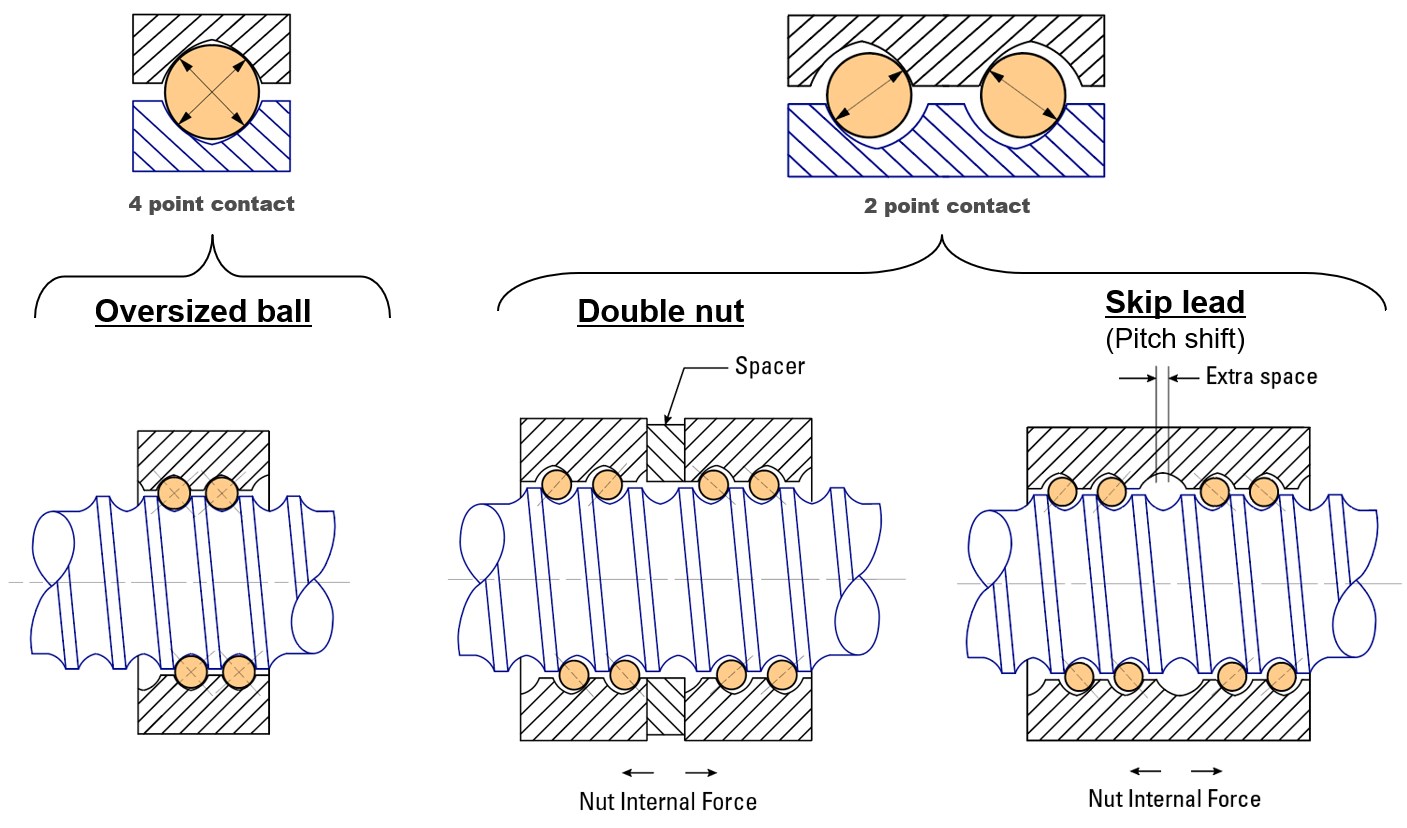
Preloaded nut designs
Preloaded nut designs
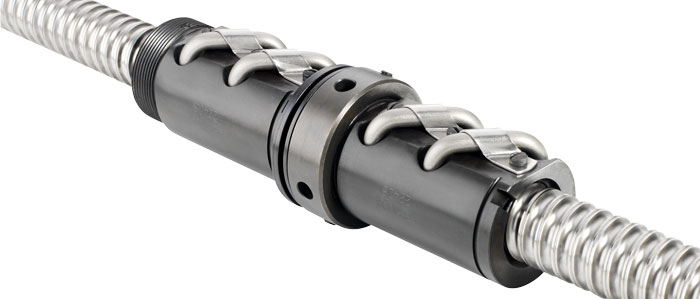
Adjustable double nut example
Adjustable double nut example
Minimum lash
An alternative to preloading is to select the
ball bearings size to reduce the lash to a minimum without creating a preload similar to what is done for an oversized ball preload. Advantages of minimum lash are less drag on the system and increased smoothness.