Thomson Linear Motion Optmized

Lead Screws - Why Lead Screws?
Design and Theory
Lead Screws
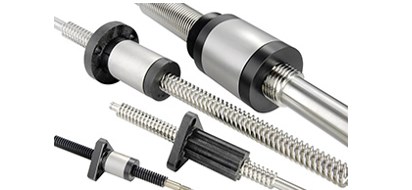
Lead Screws
Why use a lead screw assembly?
One
reason is that there is no ball re-circulation, which means no noise
from the balls. No ball bearings or ball re-circulation allows a lead
screw assembly to be more compact.
Another benefit of a lead screw is that it is not necessary to harden the screw. Screws can be made of corrosion-resistant stainless steel. Soft screws mean that there is no need to anneal the screw prior to machining the ends.
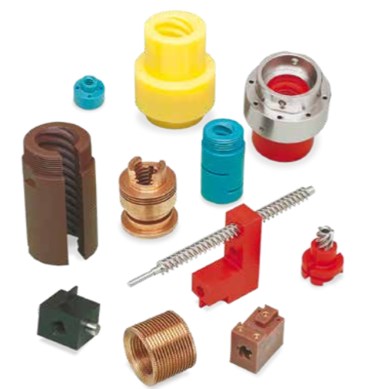
A Selection of Custom Nuts
A Selection of Custom Nuts
High-performance-to-price ratio
A lead screw assembly is a simple design with few parts. With so
few
parts, the nuts are easier to customize. Custom sizes and designs can
be created quickly to match unique applications. Nuts can be made of
custom polymers or bronze. Nuts can be molded, tapped or machined
Internally
lubricated plastics and optional PTFE coatings reduce or eliminate
service requirements. 300 Series stainless steel screws and plastics are
good choices for clean room or instrument-grade applications.
Many lead screw choices are self locking. This reduces the need for a brake on vertical application or to hold a load.
This all adds up to a high-performance-to-price ratio (value).

Ball vs. Lead Screw
Often, when selecting components for linear motion, there is a question of which is better to use - a ball screw or a lead screw? The video above discusses many of the differences between the two.